Up next in 10


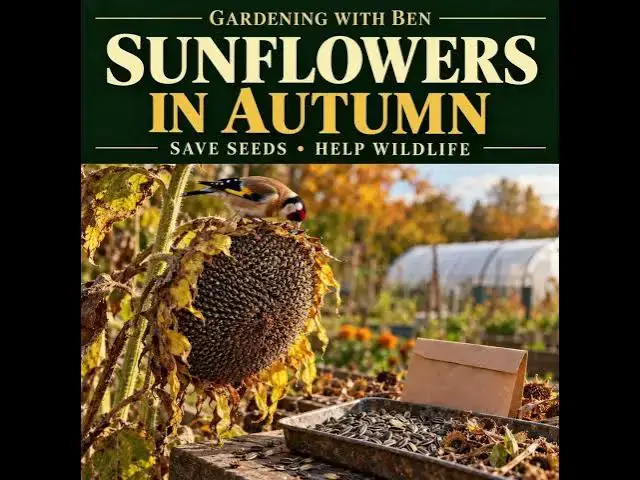
Before you clear away your faded sunflowers, take a closer look at those seed heads! They could provide seeds for next spring and a valuable meal for visiting birds.Join me, Gardening with Ben, as I explain what to do with sunflowers after flowering, from recognising ripe seeds to drying, collecting and storing them.In this episode:
• Why faded sunflowers still have value.
• Recognising when sunflower seeds are ready.
• Cutting and drying seed heads.
• Removing, labelling and storing seeds for spring.
• Why saved seeds may produce different flowers next year.
• Leaving seed heads for garden birds.
• Clearing finished plants and planning next season’s display.Whether you want to grow more sunflowers or leave a little extra food for wildlife, come along for practical advice and a friendly autumn gardening chat.Do you save your sunflower seeds, leave them for the birds, or do a bit of both? Share your experiences on the Gardening with Ben Facebook page.Follow the podcast for daily gardening conversations, seasonal tips and allotment updates. If you enjoyed listening, please leave a rating and share this episode with a gardening friend.Find more gardening inspiration:
https://gardenandallotment.com (https://gardenandallotment.com/) Keep smiling, keep shining, keep gardening with Ben.
Become a supporter of this podcast: https://www.spreaker.com/podcast/gardening-with-ben-garden-and-allotment-tips-and-advice-podcast--5150692/support (https://www.spreaker.com/podcast/gardening-with-ben-garden-and-allotment-tips-and-advice-podcast--5150692/support?utm_source=rss&utm_medium=rss&utm_campaign=rss) .
🌼 🌿 Stay Connected with Gardening with Ben:
🎥 YouTube – https://www.youtube.com/@GardeningwithBen
📸 Instagram – https://www.instagram.com/gardeningwithben
📘 Facebook – https://www.facebook.com/gardeningwithben
🎧 Podcast – Available on Spreaker, Spotify & Apple Podcasts
🌐 Website – https://gardenandallotment.com
Show More Show Less View Video Transcript
0:03
[music]
0:08
[music]
0:13
[music]
0:21
>> Hey up and welcome back to gardening
0:24
with Ben. Happy Friday everybody. It's
0:26
Friday and hopefully you are all ready
0:29
for the weekend. I won't be off until
0:31
Tuesday and Wednesday, but I hope that
0:33
you all have a fantastic weekend those
0:36
that are off. I don't think anyone works
0:38
9 to 5 these days. Monday to Friday so
0:40
everybody's all over the place. But
0:42
yeah, it's ready for the weekend.
0:45
Um today, as you'll have seen in the
0:47
title, we're talking sunflowers.
0:50
So I absolutely adore sunflowers. One of
0:53
the best things that I always grow on my
0:55
plot is one thing that without
0:57
hesitation, I will grow every single
1:00
well yeah, if I can.
1:01
And before you pull up those faded
1:04
sunflowers, there could still be
1:05
something valuable sitting in the flower
1:08
heads.
1:09
And what do we mean?
1:12
We mean the seeds inside them. So we're
1:14
going to talk about saving seeds,
1:16
leaving some for the birds, and clearing
1:19
the plants when needed. So yeah, I
1:23
absolutely love sunflowers. Now there's
1:25
so many varieties of sunflowers out
1:26
there now. You can get lemon ones, you
1:29
can get orange ones, you can get yellow
1:31
ones, you can get red ones, you can get
1:33
black ones. It's absolutely amazing the
1:36
colors and the varieties and the
1:38
different shapes, the different sizes
1:40
you can actually get now. There's so
1:42
many varieties out there. And if I could
1:45
have every single variety on my
1:46
allotment, I would do because I
1:48
absolutely love them. Not just for the
1:50
flowers, but for the bees that love them
1:52
as well. They absolutely adore them. And
1:55
I just love seeing the bees crawling all
1:57
on them during the summer time. It's
1:59
absolutely amazing. And they adore them.
2:02
And that's why one of the reasons why I
2:04
grow the flowers for the bees.
2:06
So, yeah.
2:08
Why has a sunflower still got value?
2:12
Well, annual sunflowers naturally finish
2:15
in the autumn time. So, it's around now
2:17
when they start to die off and they
2:19
start to go brown and they start to weep
2:22
or fall over and the seed heads can
2:25
remain useful after the set petals have
2:27
gone.
2:30
The flowers support the pollinators
2:31
while the seeds provide food for the
2:34
support the eating of birds. And yeah,
2:38
the birds absolutely love the seeds on
2:40
them.
2:42
And [clears throat] not just the birds,
2:43
but the squirrels as well.
2:45
So, you've got to act fast because when
2:48
they stop flowering and the squirrels
2:50
smell them,
2:51
they'll be all over them and they'll
2:53
have devastated them all within a day or
2:55
two
2:56
if they know that they've got seeds in
2:58
them because I've seen that in the past.
3:00
Absolutely, they just go for it. They
3:02
love
3:03
just ripping them to pieces and getting
3:05
all them seeds out there. Obviously,
3:07
it's good for the squirrels that they're
3:08
getting the food, but it's whether you
3:11
want to save them for the birds or
3:12
whether to grow them yourself. So,
3:16
one of the years what I did, I would
3:18
chop down all the heads. I left the
3:19
seeds in the head and I put them on my
3:22
shelf in my
3:23
greenhouse.
3:24
And the next time I came back, they'd
3:27
all been ravaged by the um
3:30
squirrels or rats or mice or birds.
3:32
Something had had the lot of them. So,
3:34
I've learned from that mistake. Not just
3:36
to leave them on the side. Either hang
3:38
them from the polytunnel roof or
3:41
take the seeds out and store them
3:43
straight away in a container.
3:46
Uh a dry proof container.
3:49
So, yeah. Make sure that you're saving
3:51
them in a good place.
3:54
But the sunflowers heads will have
3:56
literally about a hundred seeds in each
3:58
head.
3:59
Possibly the if it's a massive
4:01
sunflower, you'll have maybe a up to a
4:04
thousand in it. You'll have absolutely
4:06
loads. So, what you can do is save a few
4:09
for yourself and then save some for the
4:11
birds as well. So, that you're getting
4:13
the best of both worlds. You're saving
4:14
some for save yourself some money next
4:16
year and you're saving some for the
4:18
birds to enjoy during the winter period.
4:21
So, yeah.
4:23
How do you know when
4:25
the seeds are ready? That is a question.
4:28
So, look at the head itself rather than
4:31
choosing a harvest day on the calendar.
4:34
You'll start to see the petals fading
4:36
and the heads beginning to turn brown.
4:39
That shows you that the head is ready
4:42
and seeds have formed underneath
4:44
usually. So, the dry seeds should loosen
4:48
when rubbed from the head. What you do
4:51
is you rub off where all the petals are
4:53
on the head itself.
4:56
And
4:57
it brushes away to reveal all the seed
5:00
heads underneath them and you should be
5:03
able to see them all. So, yeah, you need
5:05
to make sure that they're fully
5:08
uh dried out before doing that. And the
5:11
best thing what I sometimes do is like I
5:13
said, I chop the heads off and then I
5:15
hang them in my poly tunnel from the
5:16
roof so that nothing can get them unless
5:19
they're Spider-Man. They hopefully will
5:22
dry out in the poly tunnel and the seeds
5:25
will dry out as well.
5:28
Once you've left it at probably about a
5:29
month, you can take those seeds out and
5:32
put them in a dry proof container or in
5:35
an envelope, but they've got to stay dry
5:37
and they've got to stay um
5:39
away from the wet or you might ruin
5:41
them.
5:43
And if the seeds are still soft, like
5:46
try a few,
5:47
and firmly attached, give them some more
5:50
time to dry out and harden up because
5:52
you can't be getting the soft seeds off
5:54
or they just won't work. They won't work
5:56
whatsoever. So, yeah, make sure that
5:58
they're
5:59
hard and they are firm like
6:02
remove easily.
6:04
That is what you want do. So, those are
6:07
the ways of recognizing that the seeds
6:09
are ready on the heads. My My are
6:11
getting ready.
6:12
They're about ready now. Um I've got a
6:15
few varieties down on my plot. I've got
6:16
some red ones. I've got some tiny ones.
6:19
Uh I've got the standard orange ones and
6:22
the yellow ones. And I think I've got
6:24
some black ones as well. So, I'm going
6:26
to be taking some heads off each one of
6:28
those and saving some seeds, obviously
6:30
labeling them up so that I know which
6:32
ones they are.
6:33
And then obviously the rest I'll give to
6:36
the birds to enjoy or maybe even the
6:37
squirrel. I might just leave the heads
6:39
on the floor for the squirrels to enjoy.
6:42
But yeah.
6:44
Choose a healthy head and leave enough
6:46
stalk attached to hang it from the
6:49
greenhouse roof. That is the best way to
6:51
do it. But make sure that it's somewhere
6:53
dry and airy to finish. Don't leave it
6:55
out in the wet or it'll ruin it.
6:58
You can either take this home or you can
7:00
actually leave them on the plot. I
7:02
haven't got anywhere to hang them at
7:03
home, so I tend to leave mine on the
7:05
allotment plot to dry out when they're
7:07
drying.
7:08
And obviously don't seal a damp head in
7:11
a plastic bag because it'll just go
7:13
moldy.
7:15
So, yeah. Check it in a few weeks to see
7:18
if it's dried out. And then the seeds
7:21
should be ready to pop out of it.
7:24
So, what's the best way of removing and
7:26
storing the seeds? So, the best way to
7:28
do it is to work over a
7:31
tray so that you don't lose any of those
7:33
seeds because once they easily pop out,
7:35
they do pop out nice and easy. So,
7:38
you might just end up losing them all
7:40
and then trying to pick them all up in
7:42
between all the dirt. But yeah, do it
7:44
over a tray as it makes it a lot easier.
7:47
And then you can easily put them away to
7:50
dry away.
7:51
So, rub the dry head gently to loosen
7:54
the seeds off. And make sure that you
7:56
separate the seeds from the loose flower
7:58
debris. What I usually do is rub off the
8:01
loose flower debris first. And then I'll
8:03
get the seeds out nice and easy. The
8:05
flower debris
8:06
rubs off nice is it? Sometimes I make a
8:09
smiley face on them. I just rub away two
8:12
eyes and then make a smile on it just to
8:13
make it look good. But yeah, that is the
8:15
way to get them out.
8:18
Use a little label paper envelope and
8:20
keep it somewhere cool and dry ready for
8:23
next year. Ready for March, April time
8:25
for sowing all them seeds again.
8:28
And write the collection year and what
8:30
you know about the parent plant because
8:32
not necessarily the flower will look
8:35
identical next
8:37
the one that it's growing on. Sometimes
8:39
you have cross contamination or
8:42
they won't grow as true plants. They
8:45
might grow a little bit different or if
8:46
they've crossbred between other
8:48
sunflowers. You never know, you might
8:50
get a new variety coming out of them and
8:52
you might have invented one. So yeah,
8:54
have a try and see how well you can grow
8:58
them for next year.
9:00
But don't roast seeds that you intend to
9:02
sow yourself. Keep those separate for
9:05
anything you're preparing for the
9:07
kitchen.
9:08
Cuz you can have roasted
9:10
sunflower seeds as well. I've never
9:11
actually tried that. Might be worth me
9:13
trying one day to see what they taste
9:15
like. I've never tried a sunflower seed,
9:17
I don't think. It's something that I've
9:19
never actually tried. Let me know if
9:21
you've tried one and how well they
9:22
taste. I really would like to know.
9:26
So will the seeds produce identical
9:28
flower flowers next year to what you've
9:30
taken off? So saved seed won't always
9:33
give you the same flower again. Seeds
9:35
from F1 hybrids don't reliably produce
9:38
the parent's characteristics. Even other
9:41
varieties can cross-pollinate, so next
9:43
year's plants may bring you a big
9:46
surprise. That doesn't automatically
9:48
make the seeds useless. Just don't
9:50
promise identical height, color, or
9:52
flower or shape. It could come out
9:54
looking like an alien.
9:56
>> [laughter]
9:58
>> I do love
9:59
how
10:00
that's how things are made through
10:02
cross-pollination. You never know, you
10:04
might come on to a winner. You might
10:06
create a different color to every other
10:08
color of sunflower out there, so yeah.
10:11
See what you can grow next year from
10:14
these seeds.
10:17
So, leaving the heads for birds, if the
10:19
plants are secure, leave some heads
10:22
standing for the birds to feed from
10:24
them. They'll soon start to see that
10:26
they red eye and they'll start to enjoy
10:28
them.
10:29
But, whatever head needs removing, it
10:31
can be dried and offered to the birds.
10:33
So, if you've got enough seeds
10:35
once you've hung them up, hang them
10:37
outside on a bird table and the birds
10:40
will come along and eat them up, yeah.
10:43
And also, you could also swap some with
10:46
some plot neighbors. You could always
10:47
give a few to a plot neighbor and they
10:49
might try growing sunflowers next year.
10:51
So, it's good to share those seeds out
10:53
with one another.
10:56
So, I hope you found that useful on
10:58
about leaving them for the birds. So,
11:00
what do you do with the plants once
11:02
they're finished?
11:04
>> [clears throat]
11:04
>> Well, you can actually use the stalks as
11:07
canes and supports. Once they've dried
11:10
out, they are pretty hard and tough. And
11:13
obviously, the bigger ones are better
11:15
and they can create like
11:17
you could make like wigwams out of them.
11:20
You could use them for your runner beans
11:21
to climb up next year. The stems are
11:24
really tough and strong and you might
11:27
possibly be able to save yourself some
11:28
money on canes as well. So, make sure
11:30
that you use them and save them for next
11:33
year. They do take a lot of rotting down
11:34
once they're dried and hard. And yeah,
11:37
you could create a new
11:40
arch red eye for the sunflowers to grow
11:42
on next year, so you can even use them
11:44
back on that again.
11:46
So, like I said, sunflowers are a big
11:48
part of my allotment life down there. I
11:51
love them and
11:52
if I could have my old plot looking with
11:55
sunflowers on, I would do. I once tried
11:57
putting them in my border on my plot
11:59
between me and my neighbor and because
12:02
the sun shines on the plot neighbor's
12:05
side,
12:06
they all pointed towards his. So, I
12:08
didn't see any of the sunflower heads.
12:09
They were all pointing at his plot
12:11
because the sunflower heads turn towards
12:13
where the sun is.
12:15
And ever since then I've had to move
12:17
them to a different place so that I
12:19
could actually appreciate the sunflower
12:21
heads and enjoy them. So, obviously make
12:23
sure when you're planting them as well,
12:25
that you plant them somewhere that you
12:27
can actually see this where the
12:28
sunflower heads are. Don't plant them
12:30
against a fence and have them show over
12:31
in your neighbor or anything like that.
12:34
Make sure that it's somewhere that you
12:36
will see the flower head itself as well.
12:39
>> [snorts]
12:39
>> So, next year we're going to be trying
12:40
to load more sunflowers. Might even try
12:42
some new varieties
12:44
and different sizes and shapes. Or we
12:46
might try growing some from the seeds
12:49
that I take from this year. Hopefully I
12:50
remember where I save them and we can
12:52
try them all next year. So, I hope
12:54
you've enjoyed today's episode. Let me
12:56
know if you're going to be saving some
12:57
seeds for growing next year or whether
12:59
you're leaving them for the birds.
13:02
Also, there's a video on his YouTube
13:03
channel as well explaining all this as
13:06
well. So, if you've enjoyed this
13:07
episode, make sure you that you drop us
13:09
a follow to stay up-to-date with all our
13:10
tips and advice. Until next time
13:12
everyone, remember, keep smiling, keep
13:15
shining, and keep gardening with Ben
13:16
everyone.
13:18
>> Another day, another seed.
13:22
A little sunshine all we need.
13:25
Keep smiling.
13:27
Keep shining. [music] Until then, keep
13:29
gardening. Gardening with Ben.
13:33
See you tomorrow.
Hobbies & Leisure