Up next in 10



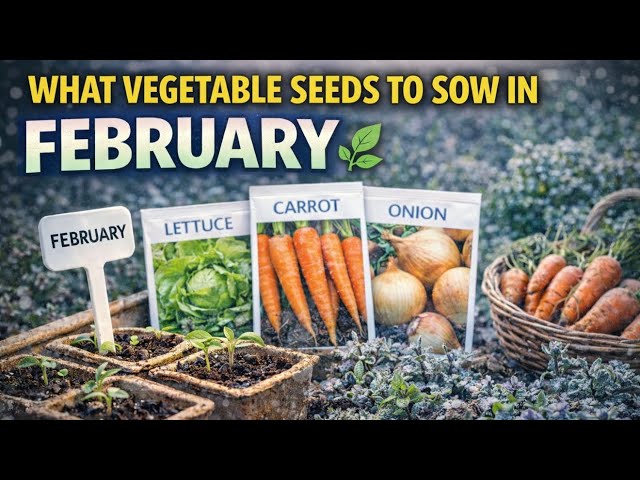
This video explains which vegetable seeds are best to sow early in the growing season and how to give them the best possible start. It covers suitable crops for early sowing and the conditions needed for successful germination.
The guide discusses using seed trays, suitable compost, light levels and temperature control, along with tips for preventing weak or leggy seedlings. It also explains how starting certain vegetables early can lead to stronger plants and earlier harvests.
If you want to maximise your growing season and enjoy earlier crops, this video provides practical beginner-friendly advice for sowing vegetable seeds successfully.
Show More Show Less View Video Transcript
0:00
What vegetable seeds to sew in February
0:03
in the UK. Welcome to Gardening with
0:06
Ben. And in today's episode, we're going
0:08
to be talking about what vegetables you
0:10
can sew this month of February. So, make
0:14
sure you've got a notepad to make a note
0:16
of these or save this video for later.
0:18
Share it to any friends that get growing
0:20
or got new a lotments and share the tips
0:23
and advice with them. So let's start
0:26
with our list of vegetables which we can
0:29
start this month down at the a lotment
0:31
or in the garden. So the first ones are
0:34
for indoors or heated propagator. Now
0:38
these ones need heat and warmth to get
0:40
them germinated to get them growing.
0:42
First up is tomatoes. However, I don't
0:45
start my tomatoes in February because
0:47
they can grow leggy and not grow very
0:49
well. I start my tomatoes off in March.
0:52
I'm up north, so I'm about a month
0:54
behind people that are down south. So,
0:57
if you want to grow them at the same
0:58
time, may start them in March and you
1:00
will get some great crops. Now, these
1:02
next few ones do need starting off ASAP.
1:06
And they need heat. They need light,
1:08
natural light, and they will grow well.
1:10
And these are chilies, peppers, and or
1:14
jeans. Now, these need about 25° to get
1:17
them germinated. And these need early
1:20
starts so that they get growing into
1:22
successful plants and then you'll be
1:24
getting good harvests off them. I
1:25
started mine one year towards end of
1:27
March and they were still ripening at
1:29
end of September. So I start mine off in
1:31
January now and I get great crops off
1:34
them last year. Next one is celery. Not
1:37
one that I'll be growing because I
1:39
absolutely hate celery. Disgusting. I
1:41
don't have any tips and advice on celery
1:43
because I've never grown it. So yeah, if
1:45
you do like celery, now is the time to
1:47
be starting that off in a heated area.
1:50
Next up is salariak. Another one which
1:53
is a nice creamy vegetable. And yeah, I
1:56
might give it a try myself this year.
1:57
It's not one that I've tried before, so
1:59
I might give it a try and see how well
2:01
we get on with that. Early lettuce
2:04
varieties. Now, they obviously need heat
2:06
to get them growing, but once it gets to
2:09
like March, April time, you might be
2:11
able to start some off in a poly tunnel
2:12
and get some growing themselves.
2:16
Next up are ones that you can start in
2:19
an unheated greenhouse or a cold frame.
2:22
Now, these are broad beans, which you
2:25
need a winter variety at this time of
2:27
year so that the cold doesn't kill them
2:28
or the frost. These are usually
2:31
aquadullas. Now, the summer varieties
2:34
will be starting off around April time.
2:36
So, around this time, you need the
2:38
winter hardy varieties.
2:40
Next up are peas. Again, these need to
2:43
be a hardy variety of peas so that the
2:45
cold and frost doesn't kill them off.
2:47
But yes, start these off in an unheated
2:49
greenhouse and then plant them out when
2:51
it's a bit warmer. Next up is spinach.
2:54
Now, these are great to be sewn at
2:57
individual timings so that you get a
2:58
crop all the time. And yeah, start some
3:01
spinach off to make it big and strong
3:03
like papay. Next up are spring onions,
3:06
hence the word spring. Start them off
3:08
now and then plant them out when it's a
3:10
bit warmer. Early carrots. These are
3:13
usually short varieties or the round
3:15
varieties of carrots to start now. Early
3:18
beetroot. I won't be starting mine off
3:20
till March, April time, but if you want
3:22
some early beetroot, now is the time to
3:24
be sewing them. They obviously won't
3:26
grow very big at this time of year
3:27
because it's colder, but yeah, if you
3:30
want to wait until it's a bit warmer to
3:31
get sewing them, that is the probably
3:33
the best time to sew them. Lettuce,
3:36
hardy varieties of lettuce need to be
3:38
sewn if you want to sew them in an
3:40
unheated greenhouse or cold frame. It
3:43
still can get a bit cold in February.
3:44
So, you may struggle with germination,
3:47
but if you want to give it a try and
3:48
itching to grow something, try giving
3:50
that a go. Next up is the fastest
3:53
growing vegetable, which is a radish.
3:55
But it will take a bit longer because it
3:57
is still cold and yeah, I wait till it's
4:00
a bit warmer before sewing any radishes.
4:04
Next up are mild areas of the UK or end
4:09
of February. So, if you're down south
4:11
where it's warmer and milder, you can
4:13
start these ones off outdoors. Now,
4:16
these are broad beans. Again, a winter
4:18
variety, the aquadullus. Start them off
4:21
straight in the ground and get them
4:23
growing. Now, you can sometimes struggle
4:25
if you get rats or mice or squirrels in
4:27
your a lotments and gardens. They can
4:29
dig them up. So, sometimes it's better
4:30
off to start them indoors. Get them to a
4:32
decent size and then plant them out when
4:34
they're big enough. Next up are peas.
4:37
Again, they need to be the hardit
4:38
variety of peas.
4:42
And next up is garlic. If you've not
4:45
planted your garlic, get some in now
4:47
because we can still have cold times and
4:50
it can still be frosty. Garlic needs a
4:53
cold and frost to make it split the
4:55
clove into the formation to form the
4:58
garlic bulb itself. So, if it's still
5:01
cool where you are, get some in the
5:03
ground and you can still get some
5:04
growing. shallots. There's still places
5:07
where they sell shallots and onion sets.
5:10
So, if you've not got any winter
5:12
varieties of shelots and onions in, get
5:14
some in the ground now and get some
5:16
growing. Now, I will be planting my main
5:19
onions out towards end of March,
5:21
beginning of April. These ones are the
5:23
ones that you'll probably see in the
5:25
supermarkets or the garden centers now.
5:29
So, they are the perfect ones to be
5:31
planting out towards March, April time.
5:34
So yeah, I hope you found that useful.
5:36
Again, like I said, I won't be starting
5:38
any of my seeds off till March. I'll
5:40
only be growing my or jeans, my
5:42
corettes, not corettes, my or jeans, my
5:45
chilies, and my peppers. Those are the
5:47
only ones that I'm starting off now. So,
5:50
if you want to wait off, wait until
5:52
March time when it's a bit warmer and
5:54
get growing stuff in natural light in
5:56
your greenhouse and poly tunnel. That is
5:58
probably the best time to start them.
5:59
So, make sure you come back next month
6:01
to see what seeds we'll be starting in
6:03
March.
6:04
So, I hope you've enjoyed this video.
6:06
Follow us along for more tips and advice
6:08
and when we're going to be sewing all
6:10
our seeds. Until next time everyone,
6:12
remember keep smiling, keep shining and
6:14
keep gardening with Ben everyone.
Cooking & Recipes
Hobbies & Leisure
Home & Garden
Healthy Eating
Fruits & Vegetables